
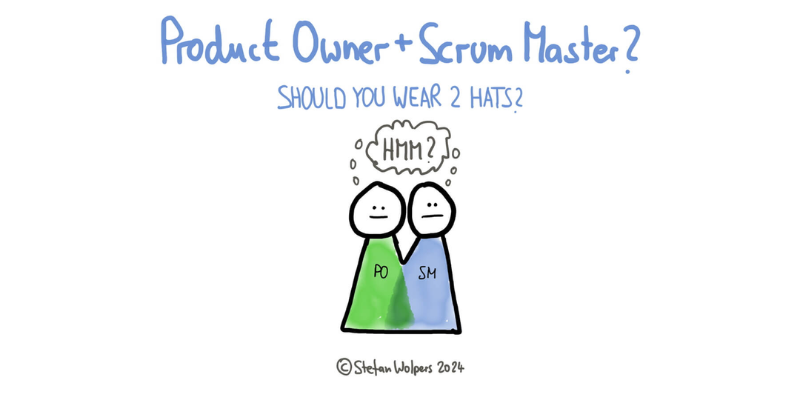
Teams are continuously searching for methods to become more efficient, quicker, and cooperative as more businesses use Agile frameworks. The concept of a single expert managing both the Product Owner (PO) and Scrum Master (SM) roles has gained traction in this changing context, particularly in startups, small teams, and early-stage Agile conversions. In order to maintain responsibility and balance, Scrum often specifies these responsibilities as distinct. However, practical limitations like scarce resources, financial concerns, and the requirement for speedier decision-making frequently force businesses to investigate a dual-role strategy.
This combination can improve product focus, decrease handoff delays, and streamline communication when used properly. In addition, it requires a high degree of self-discipline, maturity, and clarity. This article examines what abilities are needed, how to avoid typical errors while upholding Agile ideals, and when and how the dual position might offer value. This article highlights proven frameworks, tools, and Agile practices that help Scrum Masters drive high-performing teams and deliver continuous value. FITA Academy empowers learners to align modern Scrum strategies with real-world, collaborative, and customer-centric Agile environments.
Understanding the Product Owner Role in Scrum
In order to maximize the value of the product that the Scrum team delivers, the Product Owner is essential. By converting business needs into a prioritized Product Backlog, this function serves as the voice of stakeholders and customers. A good product owner creates well-crafted user stories, establishes a clear product vision, and consistently synchronizes development efforts with business objectives. They ensure that the team concentrates on delivering the greatest value features first by making important decisions on scope, priorities, and trade-offs.
The Product Owner works directly with stakeholders in daily Scrum operations, explains requirements to developers, and approves finished work during sprint reviews. For this position, strong decision-making, business, and communication abilities are crucial. Even with excellent technical execution, teams run the danger of creating the wrong product in the absence of an efficient Product Owner.
Understanding the Scrum Master Role in Scrum
As a servant leader, the Scrum Master makes sure the Scrum framework is comprehended and applied correctly. In contrast to conventional project managers, Scrum Masters empower the team to perform at their highest level rather than leading them. Sprint planning, daily stand-ups, sprint reviews, and retrospectives are among the Scrum rituals they facilitate. Eliminating organizational, interpersonal, and technical barriers that impede team progress is a major duty of the Scrum Master.
Additionally, they promote continuous improvement, teach the team on Agile concepts, and cultivate an environment of openness and cooperation. Scrum Masters collaborate closely with the organization to encourage Agile adoption and with Product Owners to manage a well-maintained backlog. An excellent Scrum Master possesses strong facilitation, dispute resolution, and coaching abilities. They continue to prioritize sustainable delivery, process efficiency, and team well-being. Build a strong foundation in Agile project management with Scrum Master Certification in Chennai, delivering industry-driven training in Scrum frameworks, sprint planning, facilitation techniques, stakeholder communication, Agile metrics, and real-world scenarios to help you succeed as a Scrum professional.
What Does the Dual Role Mean in Agile Teams?
A single person carrying out both the Product Owner and Scrum Master duties within the same Scrum team is referred to as having a dual function. Although keeping these responsibilities distinct is generally advised by Scrum principles, there are some situations when this combination is feasible. There are frequently insufficient resources for small teams, startups, proof-of-concept projects, or teams that are new to Agile.
A dual-role professional can assist sustain momentum in these situations as the business develops. However, because the duties might occasionally clash, this position calls for self-awareness and clear boundaries. For instance, a Scrum Master shields the team from pressure, whereas a Product Owner concentrates on optimizing value. The complexity of the product being created, organizational support, and experience all play a role in successfully managing this balance.
Benefits of Combining the Product Owner and Scrum Master Roles
When done well, the dual position can benefit Agile teams in a number of ways. Faster decision-making is a significant benefit since the same individual is in charge of both process facilitation and product priority. This lessens delays brought on by misunderstandings and handoffs. Additionally, the dual function ensures that backlog priorities are reasonable and attainable by strengthening the alignment between team execution and product vision. I
This method reduces overhead and makes cooperation easier for smaller teams. A single point of contact also helps stakeholders by improving accountability and clarity. The dual function can speed up learning and iteration for MVP development or early-stage products. When speed and agility are crucial, these advantages make the strategy appealing. A Sales Training and Placement Program at a B School in Chennai enhances career readiness by building strong business strategy, communication, and negotiation skills. It prepares you to confidently secure top sales and corporate roles.
Risks and Challenges of the Dual Role
Combining the responsibilities of Scrum Master and Product Owner has benefits, but it also has drawbacks. Conflict of interest is one of the major dangers. While the Scrum Master should guard against overcommitment, the Product Owner could advocate for greater scope.
Because the same individual assesses both process and product decisions, there is also a chance that objectivity will be diminished during retrospectives. Burnout and overload are frequent issues, particularly in complicated undertakings. The dual function may jeopardize Agile methods, impair team morale, and produce worse-quality results if it is not handled appropriately. Making the dual position sustainable requires early detection of these dangers.
When Is the Dual Role Appropriate?
Rather than being a long-term default, the dual role functions best in particular situations. Small teams, startups, internal tools, and short-term, narrowly focused projects are the best uses for it. A dual-role professional is best supported by teams with strong self-management skills and high Agile maturity. Additionally, it can work well in the early stages of Agile adoption, when learning and simplicity are top goals.
But when teams expand and products increase, it becomes more crucial to keep the roles distinct. Organizations should periodically assess whether role separation would lead to better results or whether the dual function still contributes value.
Best Practices for Managing the Dual Role Successfully
Professionals need to use explicit role flipping and rigorous techniques in order to succeed in dual roles. During the sprint, time-blocking helps keep the duties of the Product Owner and Scrum Master apart. Being open and honest with the team fosters trust and clears up misunderstandings. Balance is supported by actively seeking out team input and including developers in decision-making.
Seeking outside coaching or mentoring can offer impartiality and direction. Early warning indicators can be found by tracking team health and delivery performance using Agile metrics. Above all, the dual-role professional needs to stay true to Agile principles and refrain from putting speed ahead of sustainability.
Practical Tips for Maintaining Balance and Team Productivity
It takes deliberate effort and ongoing introspection to maintain balance in a dual role. Assigning specific facilitation responsibilities to team members can empower the group and lessen workload. Promoting open communication guarantees that issues are resolved quickly. Maintaining alignment is aided by regular retrospectives that concentrate on both process and product improvement. Unrealistic expectations are avoided by effective stakeholder communication. Continuous Agile training increases the efficacy of a role.
Professionals can handle the dual position without sacrificing team morale or delivery quality by using these useful techniques. These are some benefits of the Scrum Master role.
Is the Dual Role a Smart Agile Strategy?
When used carefully and in the appropriate setting, the dual job of Product Owner and Scrum Master can be a useful, focused tactic. It provides flexibility and efficiency in settings with limited resources or early-stage Agile maturity, yet it is not perfect for every team or business. Experience, openness, and a strong Agile discipline are essential for success. In the end, companies should view the dual function as a situational or short-term solution rather than a long-term one. It can facilitate quicker delivery, improved alignment, and significant product outcomes when properly balanced.